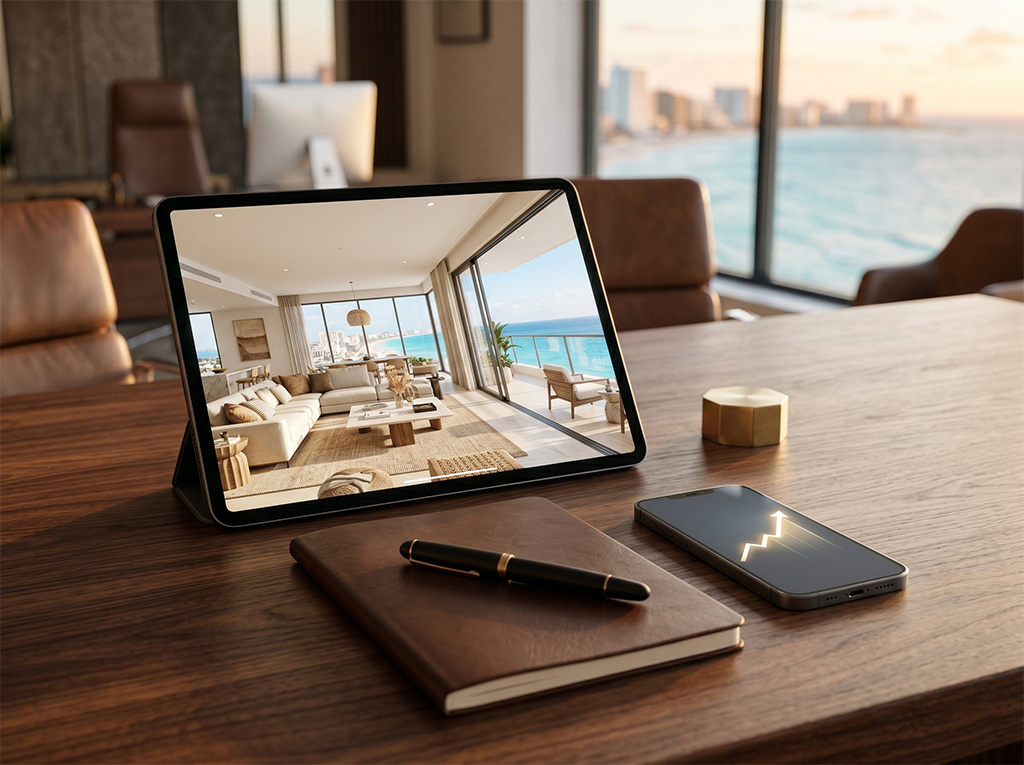
The general manager of a 28-suite boutique hotel in the Riviera Maya recently admitted, in a private conversation, that he was handing roughly 22 percent of his annual revenue to intermediation platforms. He didn't say it with resignation — he said it as a question: why do guests who find my hotel by searching its name on Google end up booking on Booking.com instead of booking directly with me?
The honest answer is uncomfortable: because the hotel's own website doesn't convey enough certainty. Booking.com does. Expedia does. Airbnb does. Not because their photos are better — often they aren't — but because they've engineered their entire experience to reduce a single variable: doubt. Reviews, flexible cancellation policies, a three-click booking path, a price guarantee. Doubt dissolves. And with it, so does the hotelier's margin.
The luxury guest's psychology: the need for visual certainty
The guest paying between $400 and $1,200 a night isn't optimizing for price. They're optimizing for perceived risk. The experience they're buying is partly material — bed, view, breakfast — and partly symbolic: the certainty that they're choosing well, that they won't arrive to discover the room was smaller than it looked or that the pool was a puddle ringed with plastic chairs. In the luxury segment, the worst-case scenario isn't overpaying. It's arriving and feeling deceived.
Consumer-behavior research in premium hospitality — Hospitality Net, EHL Hospitality Insights, reports from Skift and Phocuswright — converges on one pattern: the average luxury traveler spends more than 2 hours researching a property before booking, spread across 5 to 8 sessions and 3 different devices. In that window, the guest moves through the hotel's website, Google Maps, the OTAs, Tripadvisor and, sometimes, Instagram. The decision of where to book is made at the last touchpoint where doubt disappeared completely.
The guest doesn't book on the OTA because it's cheaper. They book on the OTA because it's the last place they doubted — and the first place they stopped doubting.
A hotel's traditional visual material — a gallery of room photos, a 90-second institutional video in the homepage header — solves the easy part: it shows the aesthetic. It doesn't solve the hard part: scale, layout, the rhythm between spaces, how the terrace relates to the bed, what you can see from the bathroom, how far the lobby is from the pool. And that's exactly where the doubt originates — the doubt that dissolves on Booking.com and not on your own site.
From OTAs to direct bookings: taking back control of your margin
OTAs serve a real function and they aren't going away. They bring the hotel travelers who would never have found it otherwise, they sustain occupancy in low season, and they provide a layer of transactional trust that even the most demanding hotel benefits from outsourcing. The problem isn't their existence. It's their dominance. When a property depends on the OTA channel for more than 50 percent of its occupancy, it starts giving up two things at once: operating margin and the guest relationship.
The margin shows up on the P&L: commissions running from 15 to 25 percent, extra spend on sponsored visibility inside the platform, rate-parity obligations, contractual restrictions on direct promotions. The relationship shows up in something less measurable but just as important: the guest ends up seeing the hotel as "one more listing on Booking" rather than a brand in its own right with which they have a direct relationship. That bill comes due when the guest wants to return: instead of going to the hotel's site, they go back to the platform.
Reported increase in direct bookings at boutique hotels that integrate a quality 360° virtual tour into their booking engine, alongside parallel brand campaigns. Typical observed ranges: 28 to 52 percent in the first 9 months.
Range observed in internal case studies and public benchmarks for the boutique hospitality sector, 2024–2025.
The strategic question isn't how do I replace the OTAs — that question is wrong — but how do I cut my dependence to 30 percent so I can take back control of the other 70. The operational answer combines three layers: a recognizable brand, visual content that resolves doubt before the platforms do, and a booking engine on your own site as smooth as Booking's. The 360° tour operates on the second layer — but if the other two don't exist, its impact shrinks.
How immersive content justifies premium rates
There's an additional function of the 360° tour that's rarely mentioned in sales pitches and that is, probably, the most important in the luxury segment: it justifies the rate. When a guest compares two $600-a-night suites at two different hotels, the comparison happens first in the guest's head and then on the hotel's page. If the first hotel's 360° tour clearly shows the suite's scale, its integration with the terrace, the view, the design of the tub, the rhythm of the lobby — and the second hotel's doesn't — the first hotel's rate stops looking high. It looks correct.
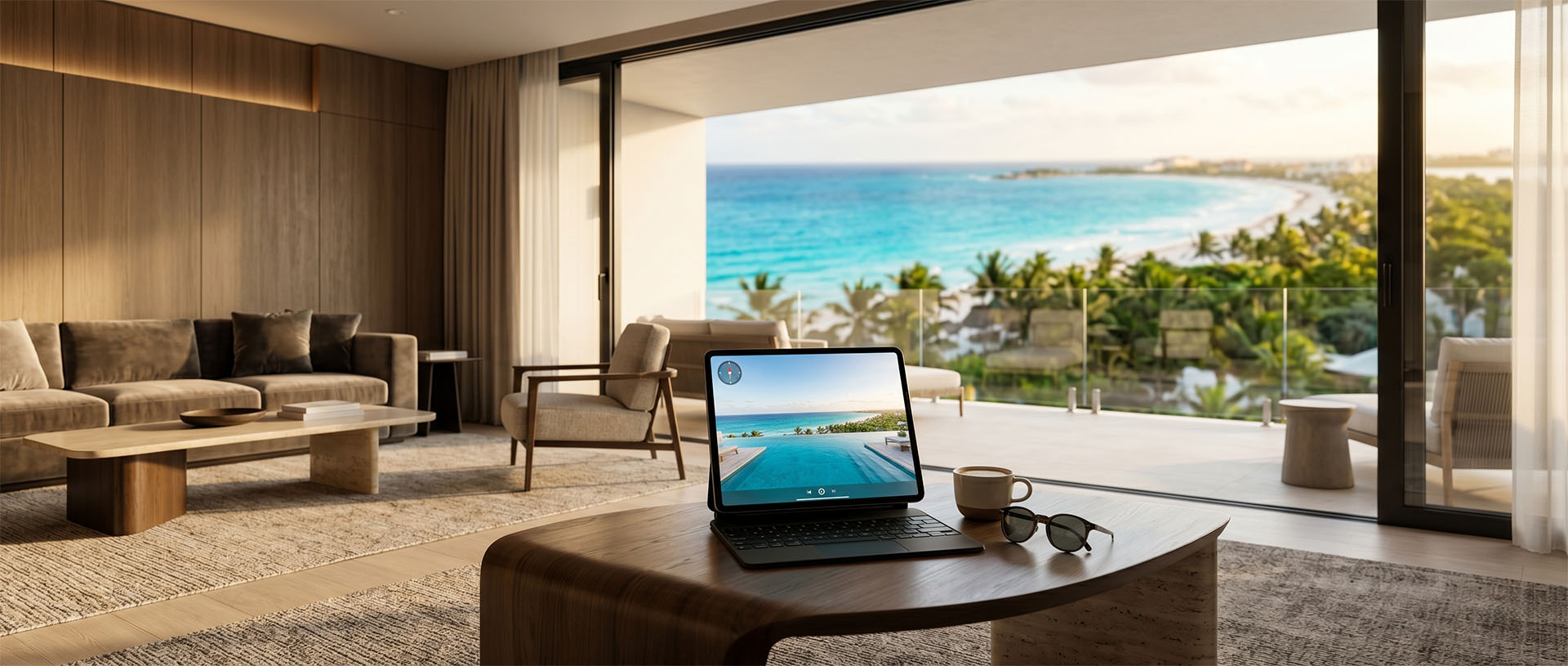
The difference is semantic, but commercially it's enormous. A high price gets negotiated. A correct price gets paid. The transition from one to the other depends almost entirely on how well the guest can project themselves inside the space before booking. A static photo and a 90-second video let you appreciate the aesthetic; the 360° tour lets you step inside.
Key elements of a conversion-focused virtual tour
A 360° tour shot by a photographer who also shoots weddings isn't the same tool as a 360° tour produced by a team that specializes in conversion-focused hospitality. The difference isn't in image quality — both can be technically correct — but in the narrative architecture and the integration with the booking engine. The elements that separate one from the other are specific:
- Narrative sequence, not catalog. The tour starts at arrival (the porte-cochère or entrance), moves to the lobby, to the social spaces, and only then enters the rooms by category. It isn't an index, it's an arc.
- Lighting that matches the selling moment. A hotel that sells a sunset experience shouldn't have its tour captured at noon. The capture time is part of the narrative.
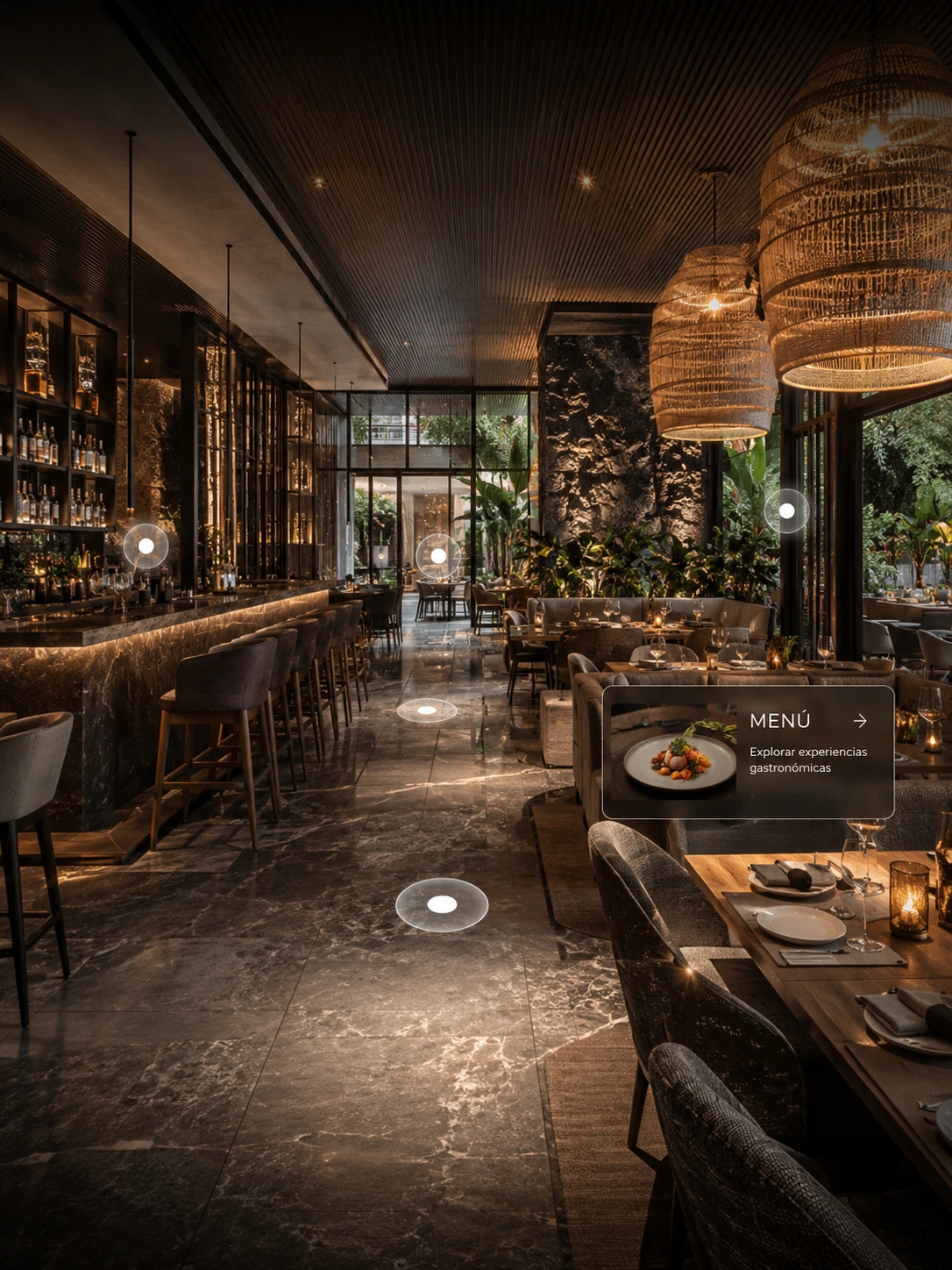
- Transactional hotspots. Every room in the tour should have a hotspot that leads to the booking engine with the room type pre-selected. Without this element, the tour is tourism; with it, it's sales.
- Optional audio layer. Silent by default, with the option to turn on ambient music or voice narration. The silence respects the office context where the tour is usually explored.
- Integrated wayfinding. The guest should always be able to tell where they are inside the hotel — a floating map, a visual breadcrumb, a top label.
Integrating hotspots, menus and a direct booking engine
Integration with the booking engine is the point where most projects fail, and also the point where almost all of the tour's return is decided. A 360° tour that ends with a generic "Book" button leading to the site's homepage loses between 40 and 60 percent of the intent. By contrast, a tour where the user is inside the presidential suite and the hotspot takes them straight to the engine with the Presidential Suite category already selected and the dates pre-filled from a session cookie closes the sale in that very moment.
There's a technical detail worth mentioning: this level of integration requires the hotel to have direct access to the booking engine and not depend solely on an external widget. Platforms like Cloudbeds, Mews, SiteMinder or Opera Cloud offer APIs that let you pre-select room type and dates. When the tour is built respecting that architecture, the full mechanic goes from "look" to "book" in fewer than three clicks. The complete technical implementation — from hotspot configuration to the multichannel distribution stack — is something we build into our 360° virtual tours for business service for the hospitality model.
Use case: maximizing ROI in Riviera Maya hospitality
The Riviera Maya is a particular case within the global hotel landscape because it concentrates three phenomena at once: a very high dependence on international travelers (more than 75 percent in Cancún and Tulum), fierce competition among boutique hotels that look alike in their marketing material, and a saturated density of OTAs that own the first page of Google for almost any generic search. That turns the 360° tour into a tool not of aesthetic differentiation, but of economic efficiency.
The return math isn't complicated. A 30-suite boutique hotel with an average rate of $450 a night and 65 percent annual occupancy generates around $3.2 million in revenue. If 45 percent of those bookings come via OTA at an average 18 percent commission, the hotel pays roughly $260,000 a year in commissions alone. Recovering 10 percentage points toward direct booking — a conservative target after integrating a quality 360° tour — frees up around $57,000 a year. The full production cost of the tour is a small fraction of that number.
There's one last strategic point, and it's the one hotel general managers tend to overlook: the 360° tour doesn't just reduce dependence on the OTAs; it also improves the hotel's position within them. Platforms like Google Hotels and, increasingly, Booking and Expedia let you integrate virtual tours directly into the property listing. Hotels that do it rank better in those relevance algorithms, because those platforms measure how long the user stays on each listing. A 360° tour keeps the user on the listing longer. More time on the listing means a better ranking. A better ranking means more bookings with the same commission budget. The tour works for the hotel from both sides of the channel at once.
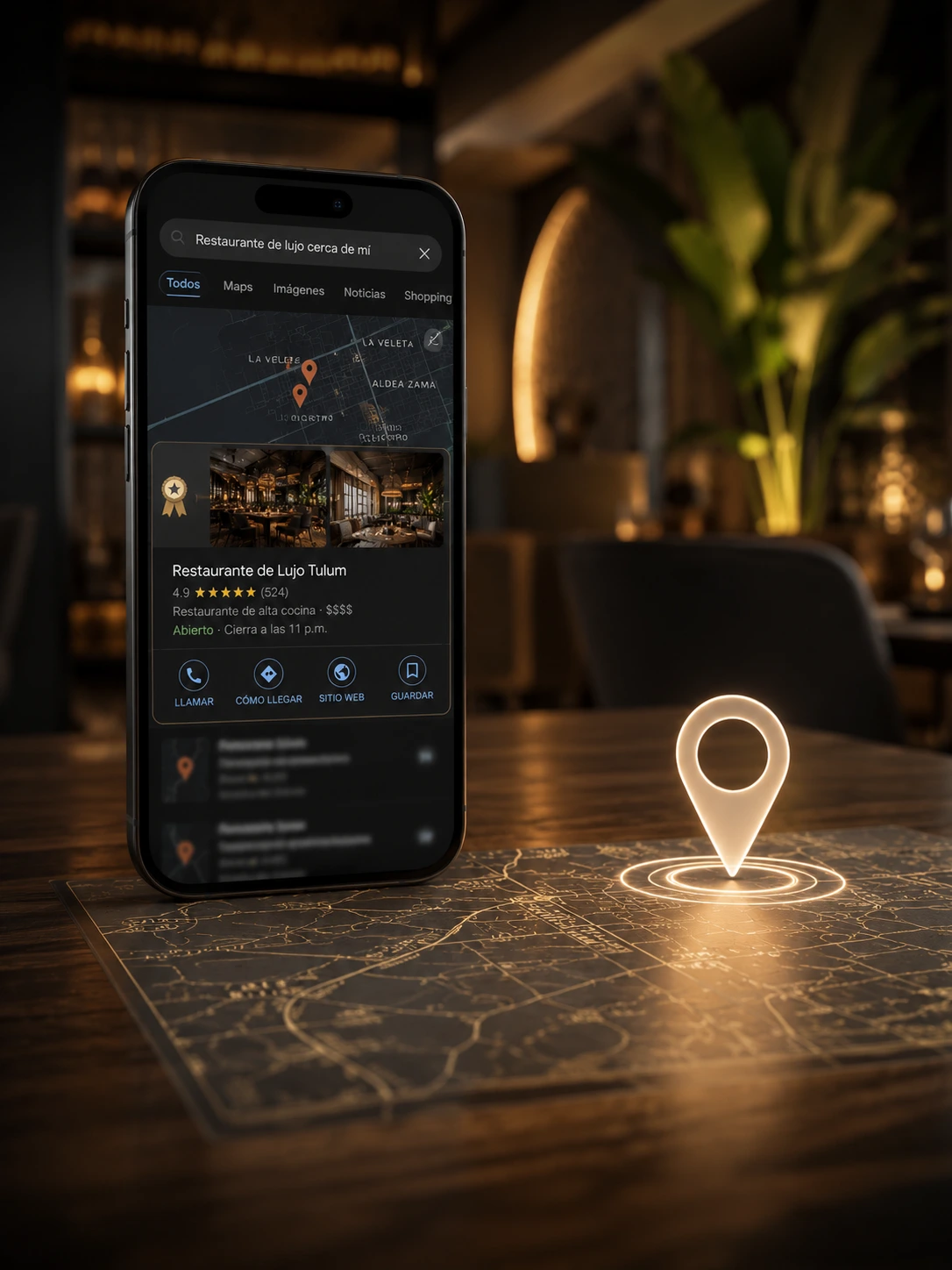
If you're interested in the technical layer — how to measure exactly what's happening inside the tour, which hotspots convert and which don't, how to connect everything to GA4 and retargeting audiences — read our guide on the ROI of virtual tours, measured honestly. And because so much of this depends on being found in the first place, our breakdown of how to rank first on Google Maps with an integrated tour explains how the same asset pulls qualified guests in before they ever reach an OTA.
Stop paying commissions for a doubt your website can resolve.
If you run or own a boutique hotel in Cancún, Tulum or the Riviera Maya, a 30-minute session is enough to map which friction points Booking is solving for you — and which ones you could resolve on your own site.