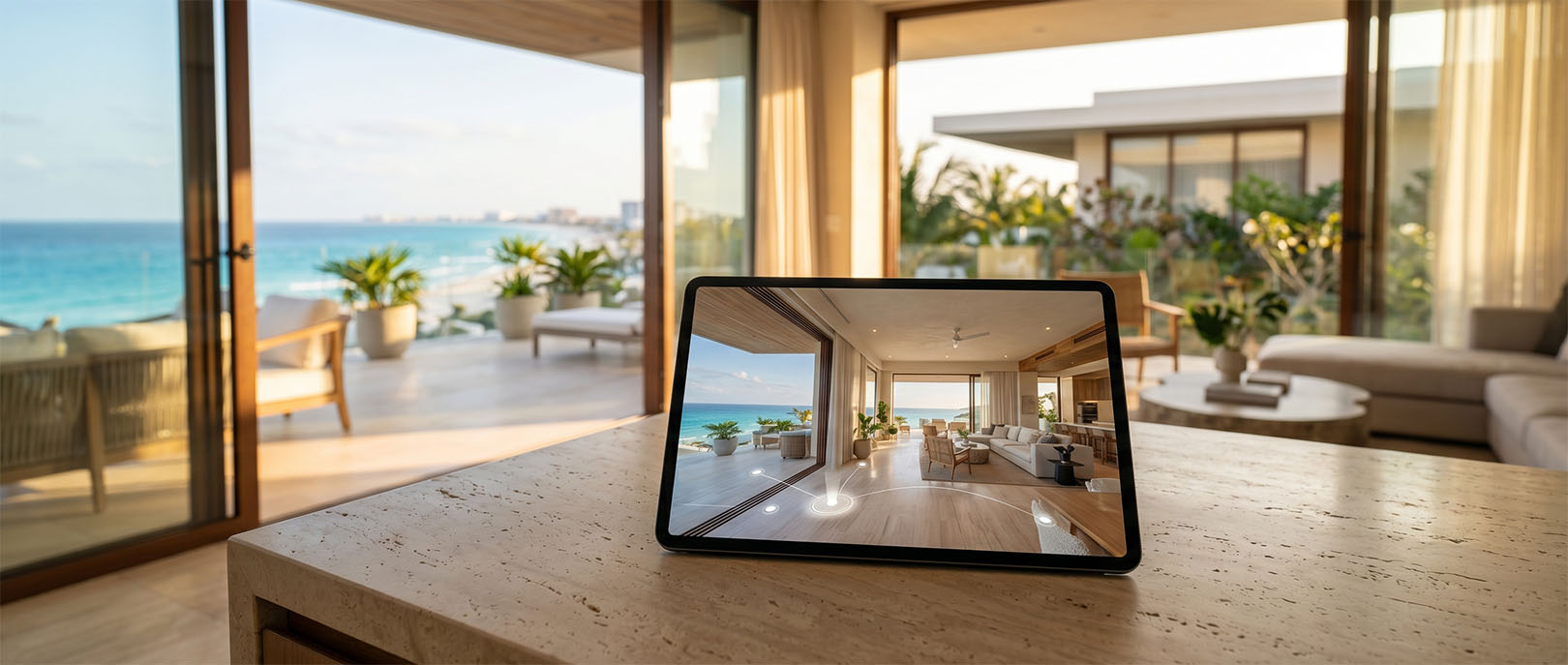
Understand what a 360 node is, how node count affects navigation, production, price and performance, and how to plan a clear route.
- A node is one navigable 360-degree viewpoint.
- More nodes do not automatically create a better tour.
- The right count depends on layout, decision points and visual continuity.
- Node planning affects production time, editing, hosting weight and usability.
What a 360 node represents
A node is a single position from which the visitor can look in every direction. Connected nodes form the route through the property or business. A room may need one node, several nodes or none depending on its size and relevance.
Why square meters alone are not enough
Two spaces with the same floor area can require different node counts. An open showroom may be explained from a few strategic positions, while a property with corridors, divided rooms and multiple decision points needs more viewpoints to maintain orientation.
- Layout and visual barriers.
- Number of floors or independent zones.
- Importance of showing transitions between areas.
- Customer questions the route must answer.
- Privacy or operational exclusions.
The cost of unnecessary nodes
Excessive nodes can make navigation repetitive, increase production and editing work, add hosting weight and create more opportunities for visual inconsistency. Visitors may also lose track of where they are.
The objective is not complete surveillance of the space. It is a clear digital explanation.
The risk of too few nodes
Large jumps between viewpoints can feel disorienting and hide important relationships between rooms. If customers cannot understand access, scale or flow, the tour may look polished while still failing its practical purpose.
A useful node-planning method
- Define the visitor and the decision the tour supports.
- Mark essential areas on a floor plan or walkthrough.
- Identify transitions that require visual continuity.
- Remove repetitive viewpoints.
- Test the route as if the visitor has never seen the space.
How LUM360 scopes nodes
We estimate nodes from the route and commercial objective, then refine the plan during scouting or production. The final count should explain the space comfortably without selling scenes that do not add value.
Frequently asked questions
Is one node the same as one room?
No. A small room may need one node, a large room may need several, and a minor room may not need to appear.
Does adding nodes increase price?
It generally increases capture, editing and QA work, although overall complexity also depends on interactivity and retouching.
Can nodes be removed after production?
Yes, but planning them correctly before capture avoids wasted work and gaps in the route.
Turn the idea into a useful digital experience.
Tell us about the space, audience and business goal. LUM360 can help define the right combination of web, visual production, analytics and immersive media.