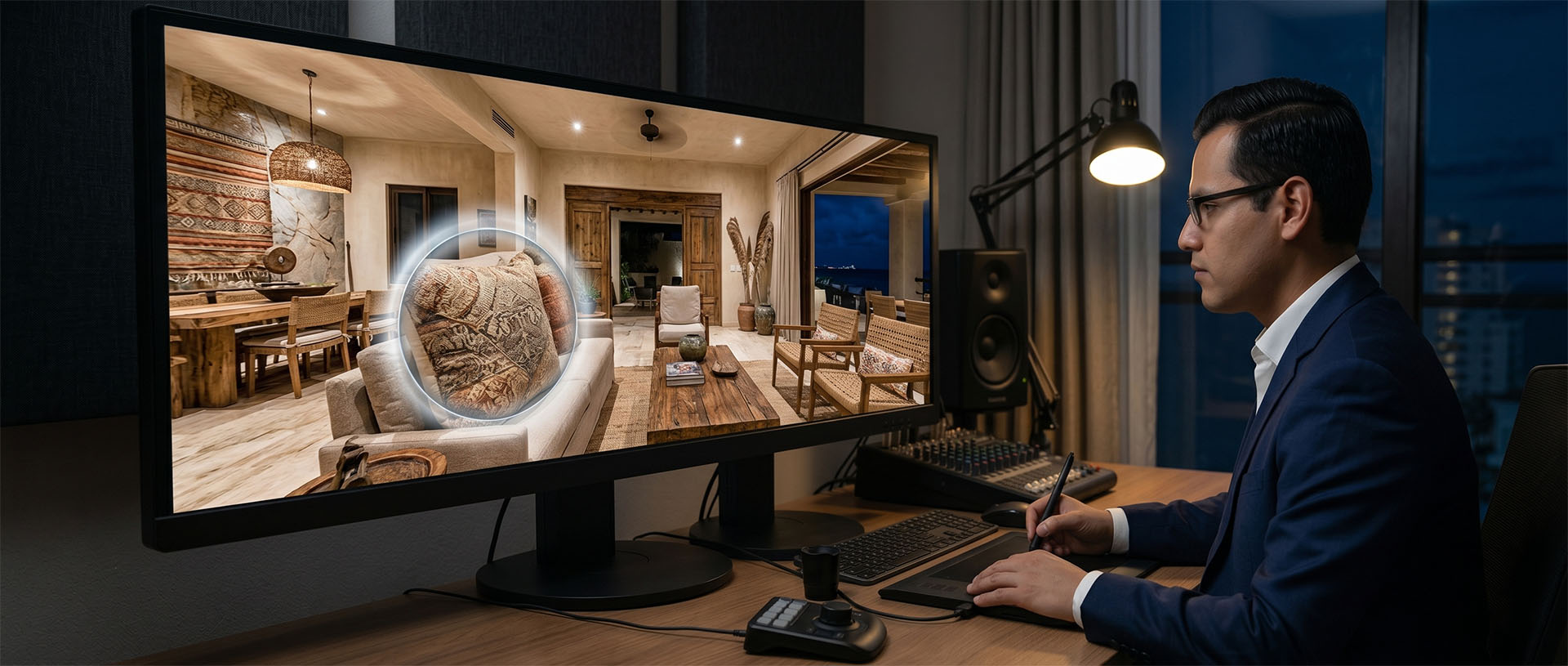
Understand advanced retouching, object removal, privacy work and scene reconstruction in immersive imagery, including scope and limitations.
- Advanced editing goes beyond routine color and stitching corrections.
- It is useful when temporary distractions or privacy issues affect important scenes.
- Edits must remain credible and should not misrepresent a property or business.
- Complexity depends on geometry, reflections, overlap and the number of scenes.
What advanced editing means
Standard post-production normally covers exposure balancing, color, horizon correction, stitching review and modest cleanup. Advanced editing may involve removing large objects, rebuilding obscured surfaces, correcting difficult reflections or protecting sensitive information across a panoramic field.
Why 360 imagery is different
A panorama surrounds the viewer. A change in one direction can affect seams, shadows, mirrors and repeated geometry elsewhere. Work that seems simple in a flat photograph may require careful reconstruction in an equirectangular image.
When it can be worthwhile
- A temporary production object blocks a critical view.
- Documents, faces or identifying details require privacy treatment.
- A minor distraction cannot be removed before capture.
- A premium scene needs consistent finishing across complex lighting.
Accuracy and ethical limits
Editing should not hide permanent defects, invent amenities or materially change dimensions. For real estate and hospitality, the published experience must remain an honest representation of what a visitor or buyer can expect.
What affects scope and cost
The number of scenes, size of the object, texture complexity, reflections, moving elements and available reference imagery all affect the work. The safest estimate follows a review of the actual captures.
The LUM360 workflow
We identify avoidable issues during scouting, capture clean plates where useful, classify edits by depth and submit sensitive changes for client review before publication.
Frequently asked questions
Can any object be removed?
Not always. Feasibility depends on what is hidden behind it and whether enough visual information exists to rebuild the area credibly.
Is deep editing included by default?
Routine corrections may be included, while substantial reconstruction should be scoped separately.
Can editing improve privacy?
Yes, through blurring or removal where technically appropriate, combined with a publication review.
Turn the idea into a useful digital experience.
Tell us about the space, audience and business goal. LUM360 can help define the right combination of web, visual production, analytics and immersive media.