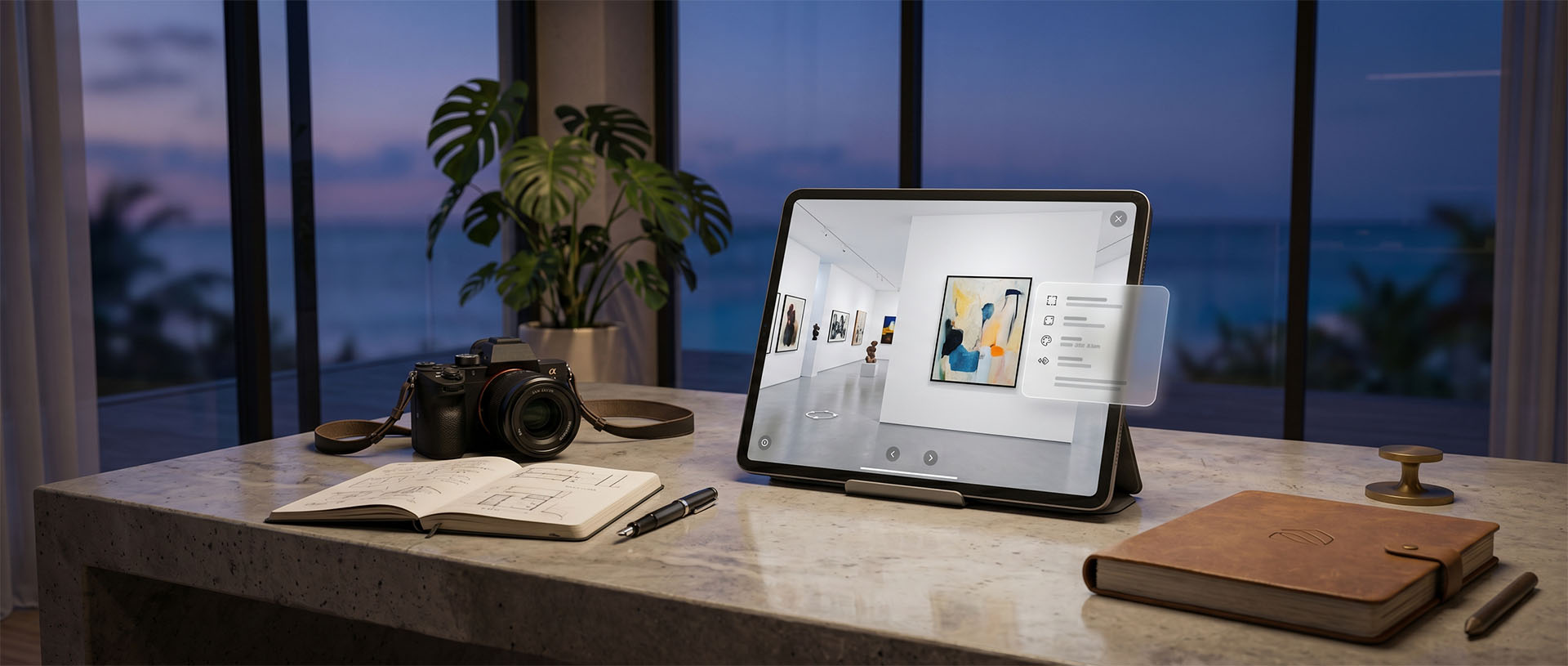
Design useful artwork records for immersive exhibitions with titles, artists, media, context, accessibility and sales information without visual overload.
- Artwork labels should answer the visitor’s immediate question without interrupting exploration.
- Use a consistent information hierarchy across the exhibition.
- Separate essential facts from optional curatorial, media or sales detail.
- Accessibility and rights information should be planned from the start.
Essential information
A useful record normally begins with artist, title, year, medium and dimensions. Add collection, edition or credit information when it is relevant and approved. Keep labels consistent so visitors can scan them quickly.
Curatorial and educational context
A concise interpretation can explain technique, historical context or the relationship between the work and exhibition. Longer essays, interviews or references are better opened as optional layers rather than placed directly over the gallery view.
Optional media and interaction
- Audio description or curator commentary.
- Detail images for material or technique.
- Captioned video or artist interview.
- Related works and exhibition navigation.
- Contact or acquisition information when appropriate.
Information for commercial galleries
Availability, price, edition and inquiry actions may be included according to gallery policy. Do not expose private collector data or imply availability when inventory is not synchronized.
Accessibility and rights
Provide meaningful alternative text, transcripts or captions for media, readable contrast and keyboard-accessible controls. Confirm image, text, music and reproduction rights before publication.
Avoiding information overload
Use progressive disclosure: show the essential record first, then let interested visitors open deeper context. The gallery should remain navigable even when a work has extensive documentation.
Frequently asked questions
How long should an artwork description be?
Long enough to add useful context, but concise at the first level. Extended interpretation can open separately.
Can labels include prices?
Yes, when that matches gallery policy and the information can be kept current.
Should every work have audio?
No. Use audio where it adds interpretation or accessibility value, not as a requirement for every object.
Turn the idea into a useful digital experience.
Tell us about the space, audience and business goal. LUM360 can help define the right combination of web, visual production, analytics and immersive media.