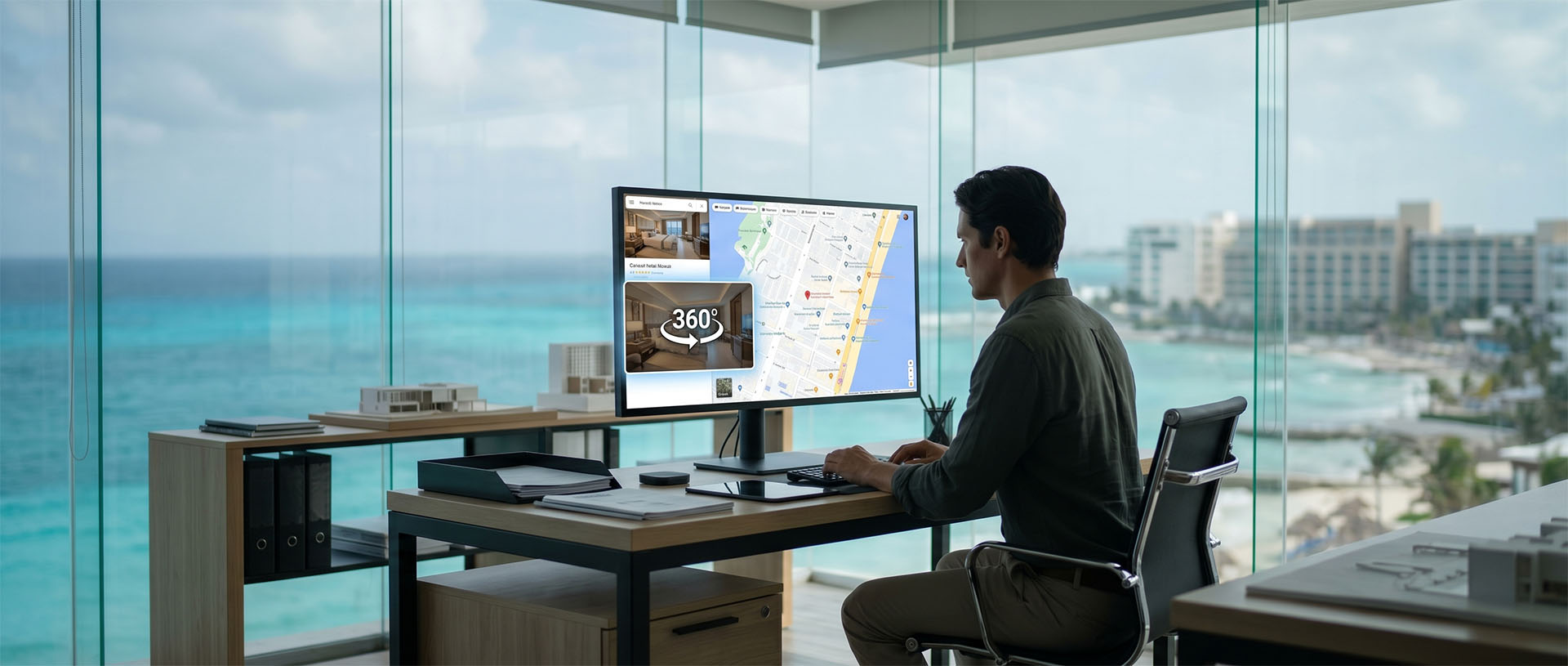
How businesses can use accurate Google Maps information and immersive visual content to build confidence before a visit, booking or inquiry.
- Google Maps is often the first place customers compare local businesses.
- A virtual tour helps answer questions about atmosphere, access, scale and layout.
- The tour should support the listing and website rather than exist as an isolated asset.
- Sensitive areas and outdated scenes should be reviewed before publication.
Maps is often the real first impression
Customers searching for a nearby restaurant, clinic, hotel, showroom or service business frequently make an initial decision inside Google Maps. They compare distance, reviews, photographs, operating hours and how easy it is to contact or visit each option.
That means the listing is not merely a directory entry. It is a compact decision page, and every visual element influences whether the customer continues evaluating the business.
What a virtual tour adds
Static photographs show selected moments. A virtual tour adds spatial context. Customers can understand how the entrance connects to the reception area, how tables are arranged, whether a venue feels open or intimate, or what facilities they can expect on arrival.
The goal is not to show every corner. It is to make the parts of the space that matter to the decision easier to understand.
Plan the tour around customer questions
- Which areas create the strongest first impression?
- What does a first-time visitor need to find quickly?
- Are accessibility, parking or arrival points important?
- Which spaces should remain private or excluded?
- What action should follow the tour: route, call, reservation or quote?
Answering those questions before capture produces a more useful experience than simply connecting a large number of scenes.
Connect Maps, the website and conversion actions
The same tour can support several points in the customer journey: the Google profile, a website location page, a reservation flow, a sales presentation or a QR code at an event. Each placement should make the next action obvious.
Use consistent business information and track outbound clicks where the platform allows it. The tour becomes more valuable when the team can see whether people continue to call, book, request directions or explore another page.
Common mistakes to avoid
- Publishing scenes that no longer reflect the business.
- Showing private offices, personal information or restricted areas.
- Using too many navigation points without a clear route.
- Letting the experience load slowly on mobile.
- Expecting visual content alone to solve inaccurate categories, weak reviews or incomplete business information.
How LUM360 approaches the project
We define the commercial role of the tour before production: improve arrival confidence, support reservations, explain facilities or reinforce a local sales page. Capture, editing, privacy review, hosting and integration are then planned around that role.
Frequently asked questions
Does a virtual tour automatically improve a Google Maps ranking?
No. It can improve the customer experience and visual confidence, but rankings involve relevance, distance, prominence and many other signals.
Should every room or area appear?
No. Include the spaces customers need to understand and exclude private, sensitive or repetitive areas.
Can the same tour be embedded on a website?
Usually yes. The publishing and hosting setup should be planned so the experience works reliably across the intended channels.
Turn the idea into a useful digital experience.
Tell us about the space, audience and business goal. LUM360 can help define the right combination of web, visual production, analytics and immersive media.