Physical retail has been hearing for more than a decade that ecommerce will replace it. What never fully happened, and the reason has more to do with consumer psychology than with logistics or price, is this: shopping in a well-designed physical space triggers something in the buyer that no product page can replicate. It's the feeling of discovering something you didn't know you needed, of seeing how an object lives alongside other objects in an environment that communicates a lifestyle, of touching a texture that was invisible on a screen.
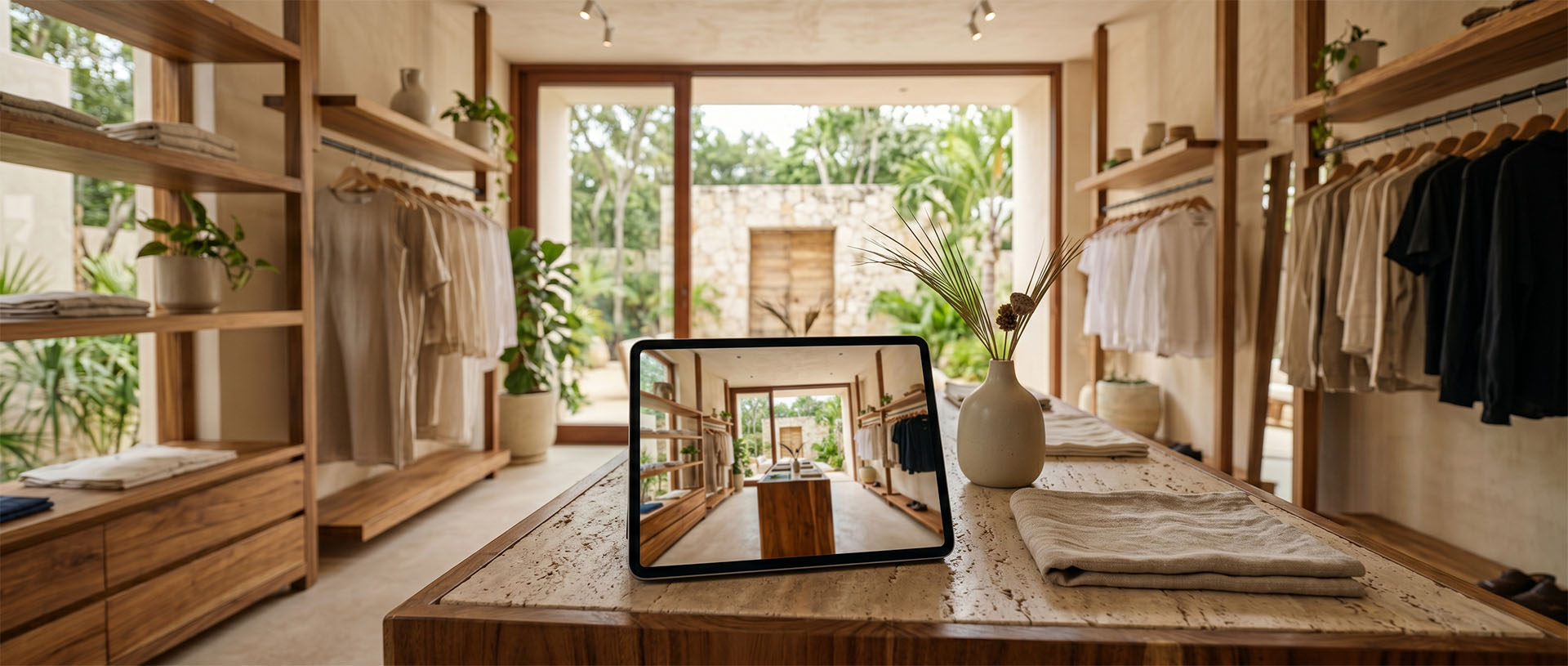
The problem with physical retail isn't the experience. It's the reach. A store in Cancún serves the people who can physically get to it. A 360 tour with product hotspots changes that equation: it turns the store's physical space, with all the richness of its atmosphere, its curation and its visual narrative, into a sales channel that's accessible from any device, anywhere in the world, at any hour.
The advantage ecommerce can't copy
There's a concrete reason luxury brands have kept physical stores despite having robust ecommerce and online sales volumes far higher than in-store: the physical space communicates things no product page can. The architecture of the store, the curation of the display, the sequence in which customers discover products as they move through the space, the light falling on a specific piece at a particular time of day: all of that is brand information that directly shapes how the product's value is perceived.
When a customer buys a product in a luxury brand's physical store, they're buying the product plus the experience of having been in that space. When they buy it on the same brand's ecommerce site, they're buying only the product. The difference in perceived value, and often in willingness to pay full price without a discount, is measurable.
A 360 tour doesn't digitize the store. It digitizes the experience of being in it, with all its narrative, its curation and its ability to create desire.
A 360 tour lets that experience of the space reach the customer before they visit the store, or instead of a visit for customers who can't get there. A customer exploring a store in a 360 tour isn't looking at products on a white background; they're seeing how those products exist in a design context, how they relate to one another and how the store communicates as a whole. That experience influences purchase intent differently, and generally more powerfully, than a conventional product page.
Product hotspots: when browsing becomes buying
What separates a store 360 tour that is a visual experience from one that is a sales channel is the product hotspots. A product hotspot is an interactive point placed on a specific item inside the tour. When clicked, it opens a panel with product information (name, price, description, sizes or variants if applicable) and a buy or add-to-cart button that connects directly to the store's ecommerce.
Implementing this flow technically requires the tour to be integrated with the store's ecommerce platform through an API: Shopify, WooCommerce, Magento or whichever platform is in use. The hotspot in the tour calls the product endpoint in real time to display up-to-date price and stock, and the buy button adds the product to the ecommerce cart using the user's session token. The customer doesn't leave the tour to buy; the transaction happens inside the immersive experience.
Higher conversion rate for products presented in their spatial context within a 360 tour compared with the same products on a conventional ecommerce page with a white background. Spatial context communicates value in a way that isolated product photography can't.
Analysis of purchase behavior in stores with an integrated tour vs. standalone ecommerce, 2024–2025.
Which types of retail benefit most
Not every retail business gets the same benefit from a 360 tour. The ones that see the highest return are those where the store space is itself part of the brand's value proposition, where curation, interior design and atmosphere shape how the product is perceived:
- Design and home decor stores. Furniture and decor pieces are inseparable from the context in which they're presented. An object displayed in a designed space communicates completely differently from the same object on a white background. A 360 tour lets customers buy the object and, at the same time, the inspiration of the space where they saw it.
- Fashion and accessories boutiques. The curation of the look, the way garments are combined on display, the atmosphere of the store: all of that is style information that influences what the customer buys. In niche boutiques where the product selection is editorial, a 360 tour extends that editorial voice beyond social media.
- Materials and finishes showrooms. Kitchens, bathrooms, flooring, cladding: in no other type of retail is seeing the product in context more important than in construction materials and high-end finishes. A showroom that can be explored virtually in 360, with hotspots showing price per square meter and stock availability, generates more qualified quotes and reduces the time architects and designers spend on reference visits. The Todo Inoxidable case study, an industrial kitchen distributor in Cancún, documents exactly this model: a 35% reduction in the B2B purchase decision cycle after implementing the showroom tour.
- Art stores and commercial galleries. Artworks don't sell well on conventional ecommerce because the price is rarely on the page, because the work needs to be seen at scale and in context, and because the sales process is more consultative than transactional. A 360 tour of a commercial gallery lets collectors explore the entire exhibition from their office, with hotspots that request information or a quote instead of a direct buy button.
- Artisan product and gourmet food stores. In markets or producer shops where the identity of the origin and the making process is part of the product's value, a 360 tour can include hotspots with a short video of the producer, the product's story and a direct purchase link. Presenting the origin story within the context of the store's space multiplies customers' willingness to pay premium prices.
360 tours and your store's organic ranking
Beyond direct conversion, a 360 tour integrated into the store's website has a secondary effect on organic ranking that's worth mentioning. Google uses average session time on a site as a signal of content quality. A store whose website has only product pages, even good ones, produces short sessions: the visitor arrives, looks at the product, decides and leaves. A store with a navigable 360 tour produces significantly longer sessions, because the visitor is exploring a space, not reading a product page.
That additional session time tells Google's algorithm that the site is relevant and that users find value in it, which translates into better organic ranking for searches relevant to the store's category. In a market like Cancún, where high-intent tourist searches are constant, that ranking has direct commercial value.
Putting it into practice: from physical space to immersive store
Producing a retail tour comes with specific considerations that set it apart from other types of tours. The main one is inventory turnover: unlike a residence or a restaurant, a store changes its displays regularly. The tour has to be planned with that cycle in mind. Some businesses update the tour each new season, while others produce it around the brand's most iconic products, which stay on display consistently.
The second consideration is choosing which products get a hotspot: not every product in the store needs one. The ones that generate the highest return are those with the highest margin, the highest volume, and those that work as entry products to broader categories, the ones customers tend to come back for once they've bought them. Choosing hotspots is a commercial decision, not just a technical one.
Immersive retail with integrated ecommerce
Capturing the retail space
- Capture
- Multi-exposure HDR, with 8–16 points depending on the size of the store, its layout and the key display areas.
- Engine
- Tour built in 3DVista Virtual Tour Pro, with a self-hosted approach and no monthly platform subscription.
Product hotspots connected to ecommerce
- Hotspots
- Product name, price, description and availability, with a real-time API call when the platform allows it.
- Integration
- Connection with Shopify, WooCommerce or Magento through REST API or GraphQL, depending on the store's architecture.
- Purchase flow
- Customers can add products to the cart without leaving the tour, keeping the immersive experience seamless.
Measurement, optimization and updates
- Analytics
- GA4 to measure most-viewed products, hotspot clicks, exploration paths and direct conversion from the tour.
- Updates
- Refreshes each season or whenever the main display changes, keeping the store's visual narrative current.
Integrating a retail tour with the online store is where LUM360's digital sovereignty philosophy has the most direct impact. A tour hosted on a SaaS platform with a monthly subscription can be deactivated, or fall out of date in its integrations, if the provider changes its API or discontinues features. A self-hosted tour, with the full source code in the store owner's hands, can integrate with any ecommerce platform without depending on a third party to maintain compatibility. To understand the difference in detail, the article on self-hosted vs. SaaS for virtual tours covers exactly that decision.
Your store already delivers a great experience. Now put it to work 24 hours a day.
If you have a physical store with a designed space and you want that space to sell even when the store is closed, let's talk. A 30-minute session is enough to evaluate how to integrate the tour with your ecommerce and which products work best as hotspots.