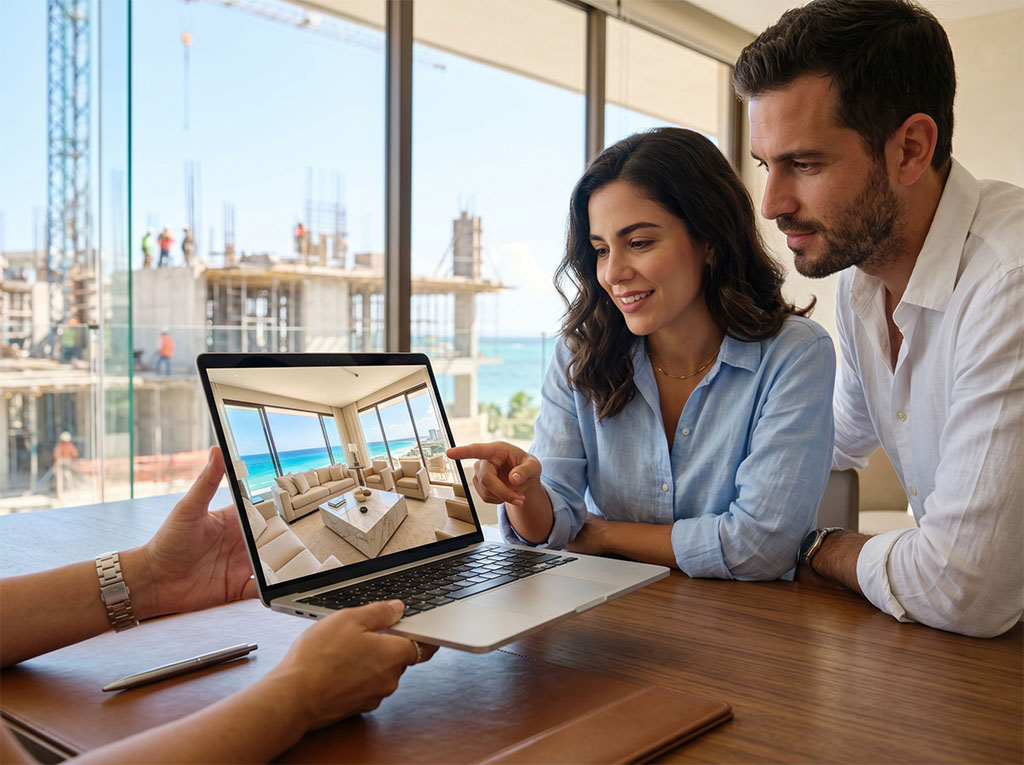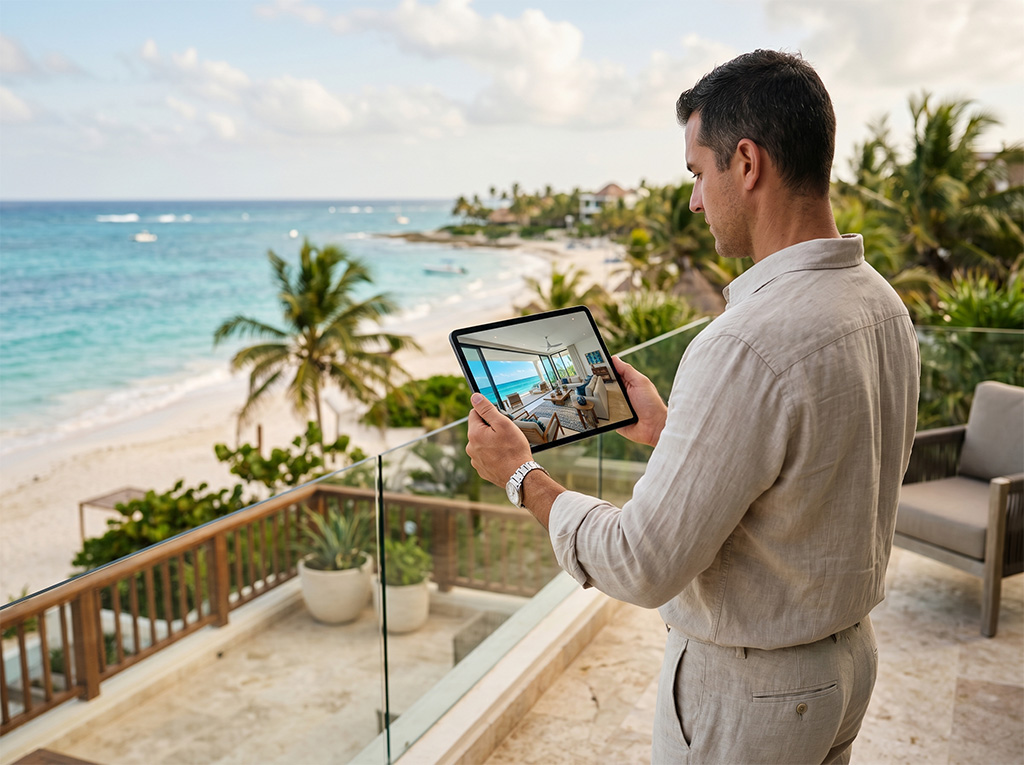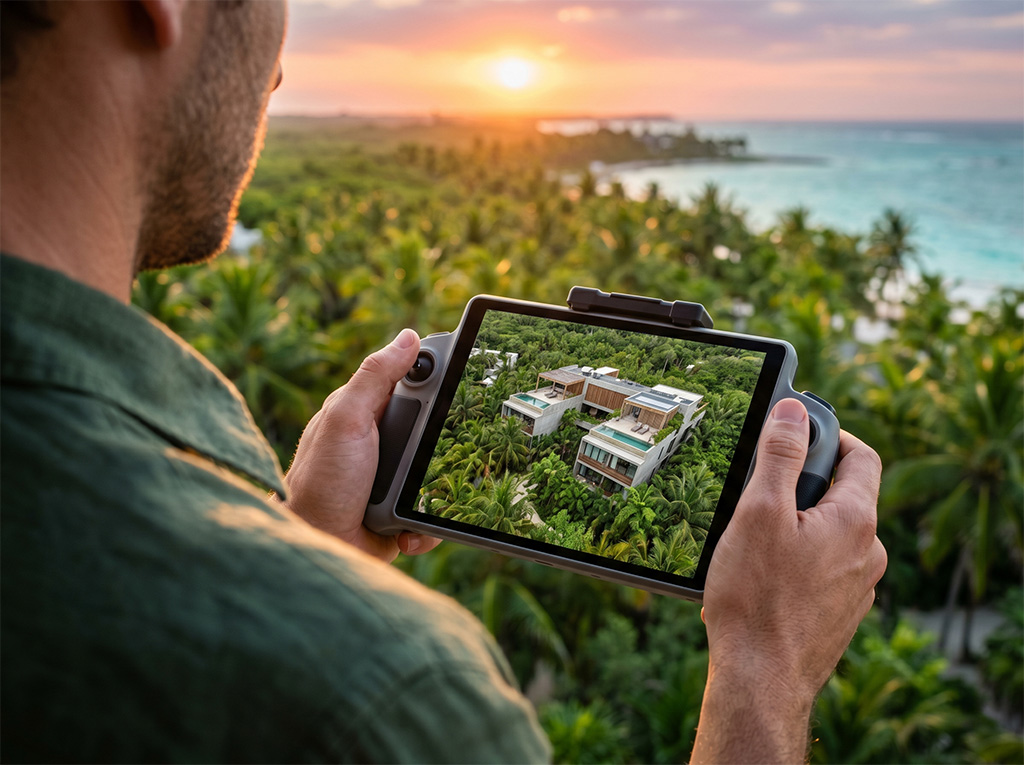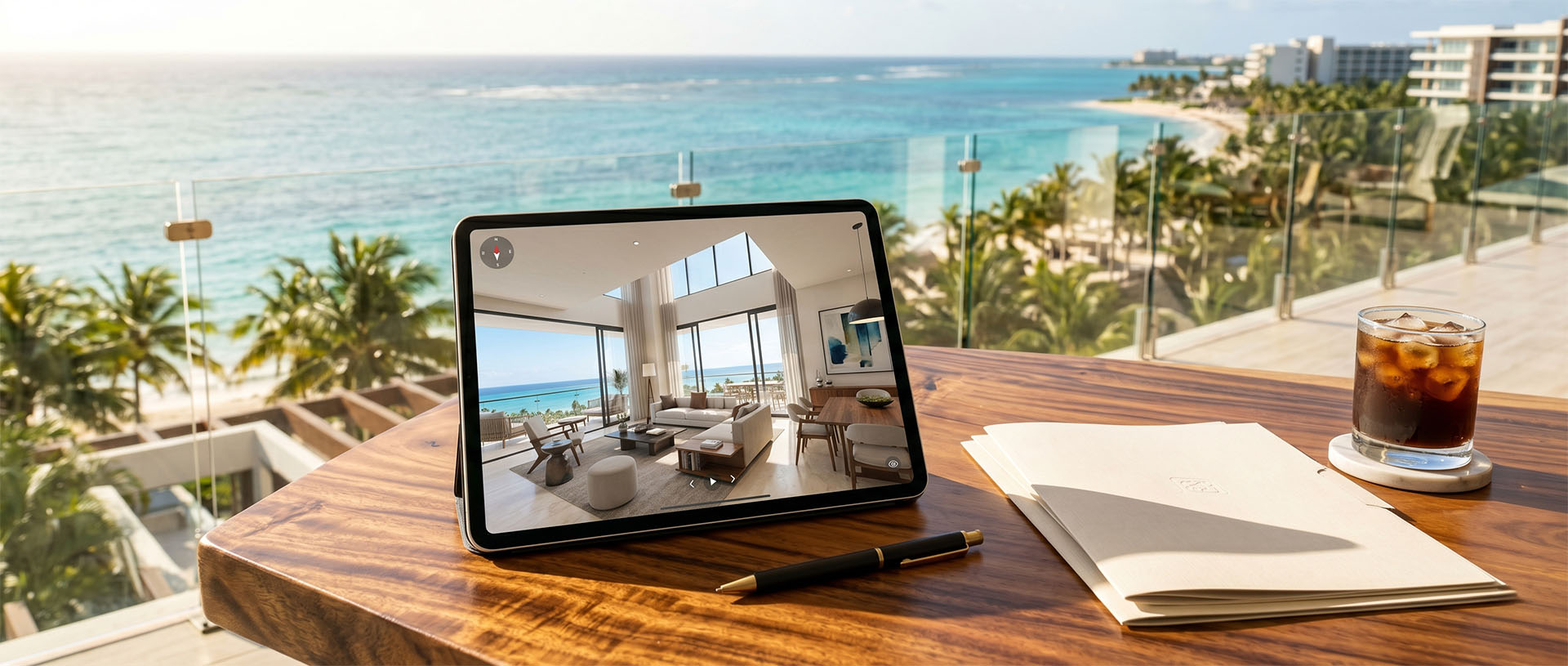
The Riviera Maya sells dreams to people who, for the most part, buy them without ever having seen them in person. Quintana Roo market data is consistent on this point: more than 70% of pre-construction buyers in Tulum, Playa del Carmen and the northern corridor toward Cancún make their purchase decision without a physical visit to the project. The buyer who flies in from Dallas or Berlin for a first sales meeting is the exception, not the norm — and will remain so as long as the decision cycle happens mainly in digital format.
For developers who understand this reality, the question isn't how to convince buyers to come visit the project. The question is which combination of materials and presentation protocol turns a prospect who has never set foot in Tulum into someone who signs a letter of intent from their office in Miami. The answer has specific components, and the 360° virtual tour is the central element — but not the only one.
The profile of the international pre-construction buyer in the Riviera Maya
The international pre-construction buyer in the Riviera Maya has traits that set their decision process apart from the local buyer's. First: their purchase goal is mostly investment, not immediate personal use. They buy to rent short-term on platforms like Airbnb or Vrbo, or as a store of value in dollars given the economic conditions in their home country. That means their questions differ from the local buyer's: instead of "What's the neighborhood like for getting to the market?", they ask "What's the average occupancy in the area?" and "How much does a similar unit earn per week on Airbnb?"
Second: the international buyer is more comfortable closing digitally precisely because they already do it in other contexts — they buy stocks, take out international insurance, open bank accounts online. Electronic signature doesn't make them uneasy if the documents are clear and the process is well designed. Third: the trust threshold for committing to a pre-construction purchase of several hundred thousand dollars without a physical visit is high, but reachable if the sales materials answer their questions before they ask them.
of international pre-construction buyers in the Riviera Maya make their purchase decision without having visited the project in person. The decision cycle happens entirely in digital format — video calls, downloadable materials, virtual tours and an electronic signature process.
Operating data reported by Riviera Maya developers with an active presence in the US, Canadian and European markets, 2024–2025.
The problem with sales materials designed for the local buyer
Most developers in the Riviera Maya produce their sales materials with the local buyer from Mexico City or Monterrey in mind: in Spanish, with Mexican cultural references, emphasizing the Caribbean lifestyle that buyer already knows. When that same material lands in an inbox in Toronto or Hamburg, it produces only a partial understanding that rarely leads to the prospect actively moving forward.
The most common problems are: a brochure available only in Spanish, prices published in Mexican pesos with no USD conversion, renders with no scale reference to help someone who thinks in square feet understand the size of the spaces, and no information about the legal process for a foreigner to buy property in Mexico (the trust, or fideicomiso; the role of the notary; acquisition taxes). A prospect who has all of these questions unanswered and has no one they trust to answer them simply doesn't move forward.
The materials stack for the international buyer
The materials stack for closing with buyers from the US, Canada and Europe has specific layers. Translating the brochure isn't enough — you have to design the communication package from the foreign buyer's perspective, answering their questions in the order they ask them.
Layer 1 — Bilingual 360° virtual tour. The tour is the prospect's first contact with the physical space. The hotspots inside the tour should be available in Spanish and English, with the option to switch languages without leaving the tour. The most important hotspots for the international buyer: area in m² and ft², unit price in USD, estimated weekly rental income in USD for high and low season, trust (fideicomiso) details and a simplified purchase process, and a direct link to WhatsApp Business or Calendly to schedule a call with the sales team.
Layer 2 — 4K drone video of the site and surroundings. The buyer in Miami needs to see with their own eyes how the project relates to the sea, the jungle, road access and the surrounding area. A 60-second aerial view answers questions a brochure can't answer credibly. Our article on 4K drone video for real estate developments details the specific shots for this type of production.
Layer 3 — An English one-pager with an ROI projection. A single-page document in English with: price in USD, area, number of units in the development, the developer's track record with previously delivered projects, a short-term rental estimate based on AirDNA or similar data for that micro-zone, and a simplified 5-step purchase process. This is the document the prospect shares with their attorney, their accountant and their partner before making a decision.
Layer 4 — English-language testimonials from previous buyers. For a buyer in Toronto who has never dealt with the Mexican real estate market, a testimonial from someone with a similar profile (another Canadian, another American) who has already completed a purchase with the same developer is a first-order trust factor. If no recorded testimonials exist, a direct contact reference — with the previous buyer's permission — serves the same function.
The video conference protocol with an integrated tour
The formal presentation call with an international buyer has a structure that sets a prepared sales team apart from one that improvises. The ideal length is 45 to 60 minutes, with the 360° tour explored on a shared screen as the centerpiece of the session.
The five-step protocol:
- Step 1 (5 min) — Market context. Two or three facts about the Riviera Maya the prospect probably doesn't know: tourism growth, recent infrastructure projects (Tren Maya, Tulum Airport), vacation rental occupancy data for the area. The goal is to establish the market's credibility before talking about the project.
- Step 2 (15 min) — Project presentation with a live tour. The salesperson shares their screen and walks through the tour in real time, focusing on the points of greatest interest for the buyer's profile (for a rental investor, show the equipped kitchen, the terrace and the finishes that make the Airbnb listing stand out; for an owner-occupant, show the privacy, the views and the amenities).
- Step 3 (10 min) — Drone video of the surroundings. Show the aerial video of the site and its context. Point out the key elements in the video: the sea at X meters, the cenote, road access, neighboring projects.
- Step 4 (15 min) — Questions and objections. With the tour available on screen, the salesperson can go back to any space to resolve specific questions in real time. There's no need to describe verbally what's already visible.
- Step 5 (10 min) — A concrete next step. The meeting ends with a defined next step: sending the English one-pager, scheduling a call with the legal team to explain the trust (fideicomiso) process, or sending the letter of intent if the prospect is ready to move forward.
The legal framework for closing a pre-construction sale remotely in Mexico
For a foreign buyer, purchasing property in Mexico in the federal zone (the 50 km coastal strip) requires setting up a bank trust, or fideicomiso — the legal mechanism that lets a foreigner hold rights to property in a restricted zone through a Mexican bank acting as trustee. This process isn't complicated or unusual — it's the standard in the Riviera Maya real estate market — but it should be explained clearly to the prospect before it becomes a surprise.
The remote closing process has defined steps that let the transaction be completed without the buyer traveling to Mexico at any point in the contract stage:
- Letter of intent signed digitally (DocuSign or equivalent)
- Due diligence: property title, building permits, INAH review if applicable (Mexico's National Institute of Anthropology and History), the developer's membership in trade associations (CMIC, AMPI)
- Notarized purchase promise contract, sent to the buyer by international courier to be signed before a notary in their home country or apostilled
- Formation of the trust with a Mexican trustee bank — the buyer signs documents that the bank sends to their address or that are handled through a power of attorney
- Down payment and a deferred payment schedule during construction, generally by international wire transfer or escrow
Developers with international market experience have attorneys or notaries on call who handle this process with buyers from multiple jurisdictions and who can communicate directly with the buyer's attorney in their home country.
The trust signals that make a remote closing possible
The international buyer who closes without a physical visit isn't acting on impulse — they do it because the set of signals they received before, during and after the video call gives them enough confidence to commit their money from a distance. These signals can be built and measured:
- A visible developer track record. Delivered projects, with real dates and reference buyers available for contact. The promise of a development is only as credible as the same team's history of past deliveries.
- A trust with a top-tier bank. Setting up the fideicomiso with an internationally recognized bank (BBVA, Scotiabank, Citibanamex) adds a layer of institutional security that signing directly with the developer doesn't have.
- Escrow for payments during construction. Depositing into an escrow account managed by a neutral third party (a law firm, a trustee) protects the buyer's payments if the developer defaults. For buyers from the US and Canada, the concept of escrow is familiar, and its presence in the process is a sign of seriousness.
- Documented delivery guarantees. A delivery date with a contractual penalty for delay, finish specifications written into the contract (not just the brochure), and a pre-delivery inspection protocol.
- International media presence or certifications. A developer with editorial coverage in Forbes, Architectural Digest México or specialized Caribbean real estate publications has a level of public validation that supports the perception that the project is serious.
Remote closing flow · International pre-construction buyer
First contact
- First material
- A bilingual immersive 3D tour paired with a 4K aerial piece of the surroundings, to present location, context and perceived value from the very first contact.
- One-pager
- An English document with the investment in USD, ROI projection, area, key attributes and a simplified legal process for buyers from the US, Canada and Europe.
Formal Presentation
- Video call
- A 45- to 60-minute session with a guided tour, market context, aerial video and real-time objection handling.
- Next step
- End the call with a concrete action: a letter of intent, a call with the legal team, or sending the sales file for final review.
Legal closing
- Due diligence
- Validation of title, permits, project documentation and relevant trade association memberships to reinforce institutional trust.
- Contract
- Purchase promise contract with a digital signature, an apostilled signature or an equivalent process depending on the buyer's jurisdiction.
- Trust (fideicomiso)
- Handled with a top-tier trustee bank, such as BBVA, Scotiabank or Citibanamex, for foreign buyers in the restricted zone.
- Payments
- International wire transfer or an escrow arrangement during construction to give the buyer and the developer greater certainty.
- Physical visit
- Optional and after closing: works as a delivery verification, not as a requirement for moving forward commercially.
The 360° tour isn't the only component of a remote closing — but it's the one that makes all the others work. Without it, the rest of the process runs on a foundation of blind faith that few international buyers are willing to maintain until signing day. With it, the buyer arrives at the video call having explored the project for minutes or hours on their own device, with specific questions and a level of understanding of the space that no brochure can generate. To see how brokers integrate the tour into the full sales cycle, our article on the tour as a closing tool for brokers complements this guide with the operating protocol.
Your project deserves buyers in Miami, Madrid and Toronto. The tour makes it possible.
We produce the complete package for the international buyer: a bilingual 360° tour with hotspots in USD, 4K drone video of the surroundings, and the technical integration needed for the material to work on a closing video call. Tell us about your project.