In B2B commerce for industrial equipment, the buying process is rarely an individual decision. The executive chef or kitchen director, the operations manager, the accountant who approves the budget and, at larger establishments, the partner or owner who wants to see it with their own eyes before signing all get involved. Coordinating that chain of approvals around a physical showroom that's only open during business hours creates an underlying logistics problem: the sales cycle stretches out not because buyers hesitate, but because they're never all in the same place at the same time.
Todo Inoxidable is a distributor of industrial kitchen equipment, refrigeration and stainless steel furniture based in Cancún. Its clients include hotels, restaurants, fast-food chains, hospitals and production plants across the Mexican Caribbean region. Sale tickets range from $180,000 MXN for a basic prep line to $950,000 MXN or more for the full outfitting of a four-star hotel kitchen. At those price points, nobody approves a purchase without having seen the equipment, or at least having absolute clarity on dimensions, finishes and configuration.
The problem: 60% of its active prospects in any given quarter were outside Cancún (Playa del Carmen, Tulum, Holbox, Chetumal, even Mérida and Mexico City), and bringing the entire decision-making team to a 2,400-square-meter showroom was logistically complex and commercially expensive.
The situation before the tour: the broken funnel
Before the 360 tour was implemented, Todo Inoxidable's sales process had a specific, measurable friction: the time between first qualified contact and budget approval averaged 47 days. That number didn't reflect customer doubt (prospects came in through referrals or high-intent searches) but the logistics of organizing the showroom visit.
The funnel worked like this: first contact → PDF catalog sent → follow-up call → visit scheduled → in-person visit → proposal presentation → approval. The bottleneck sat between the second and fourth stages. Buyers received the catalog, expressed interest, and then a chain of reschedules began: "I can't this week, let's schedule after the long weekend," "the owner will be in Cancún next month," "the operations manager is on a job site until Friday."
Todo Inoxidable's sales team spotted the pattern after analyzing 74 quotes from the previous year: 68% of the deals that took more than 60 days to close had had at least three visit reschedules. And 22% of those deals never closed at all; the client ended up buying from a competitor in their own city or chose to defer the investment.
The average of 47 days between first qualified contact and budget approval dropped to 30.5 days in the first six months of using the 360 tour. The reduction came without lowering the average ticket or the close rate.
The decision to build the tour: why 360° and not video
Before coming to LUM360, the Todo Inoxidable team considered two alternatives: a professionally produced video walkthrough of the showroom, and a series of high-resolution photographs with annotated measurements. Video was ruled out for a practical reason: in the B2B purchase process for industrial equipment, buyers don't just want to see, they want to explore. They need to position themselves in front of a specific piece of equipment, turn to see the back, check the space between adjacent units, get close to the control panels. A linear video doesn't allow that; the buyer has to follow the camera operator's path, not their own.
Photography with annotated measurements didn't solve the underlying problem either: buyers didn't doubt the measurements, they doubted how that equipment would look relative to the space available in their own kitchen. A flat photograph, however precise, didn't give the spatial perception an operations manager needs to say, "yes, the whole line fits here with no problem."
The self-hosted 360 tour was the solution for three specific reasons:
- Navigation control. Buyers can move freely through the showroom, stop in front of the equipment they care about and explore the angles they need, without depending on a guided video.
- Hotspots with spec sheets. Each relevant piece of equipment has an interactive marker that displays model, dimensions, capacity, base price and lead time. Customers get the information in visual context, not in a separate PDF.
- Asset ownership. The self-hosted tour lives on Todo Inoxidable's own domain. There's no monthly subscription to pay, no third-party watermark, and no dependence on a SaaS platform keeping the link active. When a quote closes and the client wants to look at the equipment again three weeks later, the link still works.
Production and implementation: what was captured and how it was structured
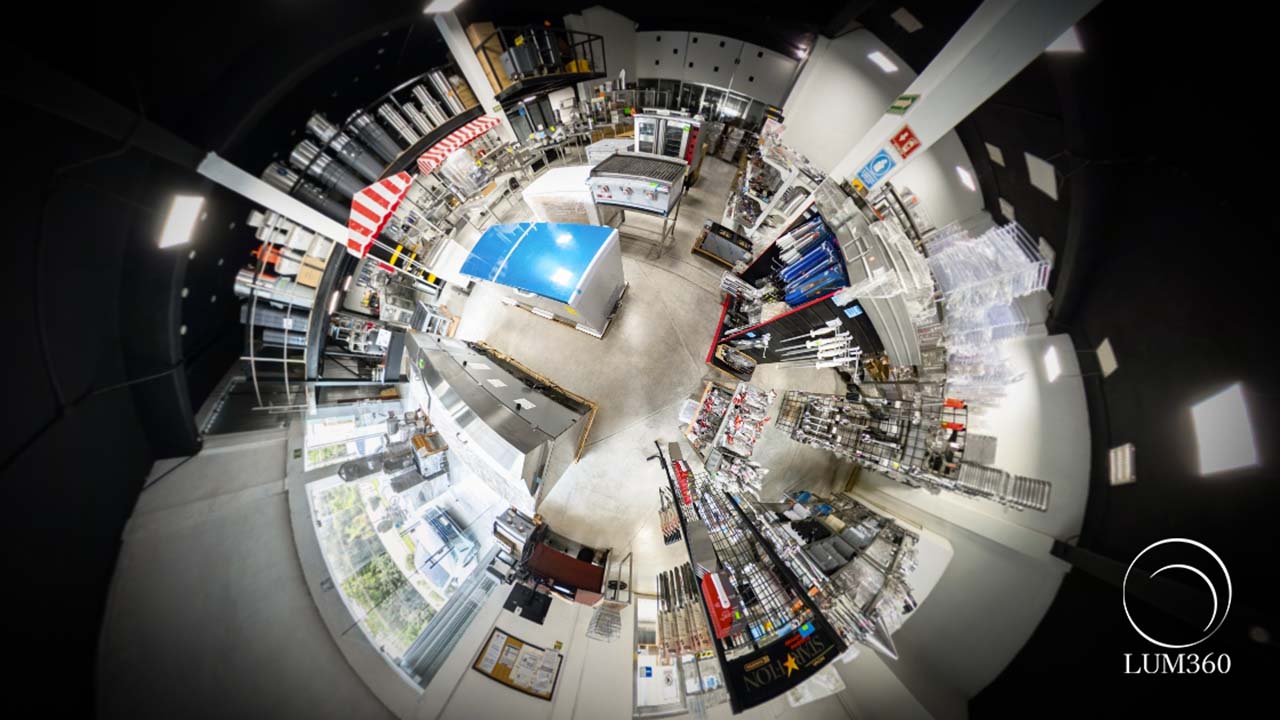
The Todo Inoxidable showroom covers approximately 2,400 m² across seven distinct zones: demonstration kitchens, industrial refrigeration line, furniture and worktables, dishwashing and ware-washing area, hoods and extractors, bakery and pastry equipment, and a display area for smaller accessories. Capture took two working sessions: one afternoon when the showroom closed early so there would be no customers in the space during the shoot, and a second morning to re-capture two zones with lighting changes.
Lighting was the most critical technical factor. Stainless steel equipment is highly reflective and can blow out the image in areas with strong spot lighting, creating reflections that distort how the finish looks. Additional diffused lighting was used in the most reflective steel zones, and the exposure of the 360° shot was adjusted to capture the full dynamic range without losing detail in the bright areas.
The hotspot architecture: information in context
What sets a B2B 360 tour apart from a consumer one is what information the buyer needs at each point in the space. In a consumer context (a pre-construction condo, a boutique hotel), the hotspot appeals to emotion and lifestyle: "here's the hot tub with an ocean view." In an industrial B2B context, the hotspot has to answer technical questions before the buyer asks them.
For Todo Inoxidable, a hotspot architecture with three types was designed:
Type 1 — Equipment sheet: Model, brand, dimensions (width × depth × height in cm), operating capacity, required voltage, power consumption (kW), water/drain connection if applicable, and base price + IVA (VAT). This hotspot appears directly on the equipment, not in a side panel.
Type 2 — Configuration note: For equipment sold in series or that must be adapted to the customer's space. It lists which variants exist, which elements can be combined, and the minimum clearance required on each side for operation and safe installation.
Type 3 — Direct quote CTA: On the highest-ticket equipment or the items most often asked about, a button that opens a form pre-filled with the equipment name, letting the buyer request a quote without leaving the tour and without having to remember the exact model.
The sales process after the tour: how it changed
The first change was at first contact. Before the tour, when a prospect arrived by referral or organic search, Todo Inoxidable's sales team sent a 48-page PDF catalog as the first piece of material. The PDF was thorough and well produced, but it had a problem: it required buyers to page through technical specifications with no spatial context, with product photos on a white background that didn't convey the real scale of the equipment or how it would look installed.
After the tour, the first thing sent to a qualified prospect is the link to the tour with a four-line intro note: "Here's our full showroom. You can explore each zone, see the spec sheets for the equipment you're interested in and click directly on the ones you want a quote for. Once you've explored, we'll schedule 30 minutes to review your proposal together." The PDF still exists, but it becomes a technical add-on that's only sent if the client asks for it.
The second change was in the quality of follow-up calls. Before the tour, calls were largely descriptive: the salesperson explained equipment features, answered questions about dimensions, cleared up doubts about capacities. After the tour, calls started with "Were you able to explore the showroom? Which equipment interested you most?" and from there moved straight to the proposal. The buyer had already done their exploration, had pre-selected models, and came to the call with specific questions about configuration and price.
Immersive tour architecture to speed up the B2B decision
Self-hosted foundation and visual map of the showroom
- Platform
- Tour hosted on Todo Inoxidable's own domain, with no third-party branding and no dependence on a SaaS platform.
- Scenes
- 22 viewpoints spread across 7 showroom zones to reveal the real flow between categories, equipment and demonstration areas.
- Availability
- A sales asset available 24/7 for buyers, operators and decision committees who can't visit Cancún in the first stage.
Technical hotspots for industrial decisions
- Total
- 61 interactive markers designed to turn visual exploration into useful technical information for B2B purchasing.
- Spec sheet
- 38 spec-sheet hotspots: one piece of equipment, one technical reference, with model, dimensions, capacity and key installation variables.
- Configuration
- 14 hotspots for variants and combinations by model, designed for kitchens, work lines and projects with specific requirements.
- CTA
- 9 direct quote shortcuts for high-ticket equipment, reducing friction between exploration, interest and a sales request.
Sales integration and operational updates
- CRM
- HubSpot form embedded inside the hotspot, with the model pre-selected so the sales team receives clearer requests.
- Updates
- Hotspots can be added or modified in under 24 hours when inventory, spec sheets or sales priorities change.
- Recurring investment
- No monthly platform subscription: the tour lives on the client's own digital infrastructure.
The data: six months after implementation
The Todo Inoxidable team measured the tour's impact across 38 closings in the six months after implementation, comparing them with 38 closings from the same period the year before. Market conditions were comparable: same seasonal range, same customer profile, similarly sized projects.
The quantified results:
- Average sales cycle: dropped from 47 days to 30.5 days (−35.1%)
- In-person showroom visits before closing: dropped from an average of 1.8 visits to an average of 0.6 visits (−67%). The remaining 0.6 corresponds to projects over $600,000 MXN, where the client always wants a confirming in-person visit.
- Quote-to-close conversion: rose from 34% to 41%. The tour acted as a pre-qualifier: prospects who explored the showroom and requested a quote had more concrete purchase intent than those who requested a quote without having seen the equipment.
- Average ticket: no significant change ($387,000 MXN pre-tour vs. $394,000 MXN post-tour). The tour didn't push purchases of more expensive or cheaper equipment; its effect was on the speed of the process, not on the makeup of the order.
One qualitative observation the sales team reported consistently: buyers who came to the first call having explored the tour arrived with a different attitude. Instead of starting the conversation by evaluating the salesperson and the product, they arrived in "I've already decided I want to buy here, I just need to fine-tune the details" mode. That shifted the call from exploratory to executive.
Beyond the industrial showroom: what applies to your business
The Todo Inoxidable case illustrates a principle that applies to any B2B business where the physical space or physical product is central to the purchase decision and where the sales process involves multiple decision-makers who are rarely in the same place at the same time.
The sectors with the greatest potential to replicate this model:
Corporate furniture manufacturers and distributors. The buyer of 200 office chairs needs to see the chair, feel the scale in the context of a furnished boardroom, and show the setting to the CEO without organizing a visit. A 360 tour of a furnished showroom does exactly that.
Medical and dental equipment distributors. The director of a hospital evaluating CT scanners or hyperbaric chambers can't travel to every manufacturer to see the equipment. A demo-room tour lets them explore the environment, installation dimensions and minimum space requirements before committing any of their calendar time.
Hotel amenity suppliers. A hotel-chain buyer evaluating beds, mattresses, bathroom furniture and textiles in a supplier showroom can do that exploration in the tour before adding the supplier to their shortlist, reducing the number of in-person visits needed to reach a decision.
What separates these cases from a consumer retail store is the architecture of the tour: while a consumer tour maximizes emotion and desire, a B2B tour maximizes the technical information available in context. The hotspots don't sell the dream; they answer the questions the purchasing committee would ask on an in-person visit.
What the tour doesn't solve: the limits of the format
Honesty about the format's limits is part of the real value proposition. A showroom 360 tour doesn't eliminate the need for an in-person visit in every case; it reduces and transforms it. For highly complex or high-value projects, the in-person visit remains part of the process, but it happens at a different point in the cycle: not as initial exploration, but as confirmation of a decision that's almost already made.
There are cases where the tour isn't enough on its own:
- Products that require a functional test. A buyer of industrial kitchen equipment who needs to see the real performance of a burner or the power of an extractor can't make that evaluation in a static tour. The tour can show the equipment, but it can't simulate its operation.
- Deep customization projects. If the client needs to adapt the equipment to their exact dimensions and the showroom only shows standard versions, the tour doesn't answer the question "how will my custom configuration look?"
- Buyers with a strong aversion to technology. In sectors where the decision-maker's profile has low familiarity with digital navigation, the tour can create friction instead of removing it. The solution here isn't to drop the tour, but to make sure the salesperson gives a guided demo over a video call before sending the link cold.
Todo Inoxidable discovered this limit when it tried to use the tour for a project with an institutional government client. Institutional purchasing has formal requirements (written quotes, official verification visits, tenders) that the tour can't replace. In that context, the tour worked as a presentation supplement, not as a tool to speed up the cycle.
Does your B2B business have a showroom or a physical catalog?
A 360 tour can replicate this result in your industry
If your sales process includes a physical visit to your showroom or facilities, there's a stretch of the cycle that can be compressed with high-fidelity visual evidence. A 30-minute analysis session is enough to evaluate whether the format applies to your case and what result is reasonable to expect.
Assess my case on WhatsAppThree lessons from the case to apply now
1. Identify the real bottleneck in your cycle, not the symptom. In the Todo Inoxidable case, the symptom was "customers take a long time to close." The real bottleneck was "customers can't see the product without organizing a trip." The tour attacked the bottleneck, not the symptom. If your sales cycle is long, identify the specific stage where it stalls before deciding the problem is "lack of follow-up."
2. The quality of the hotspots determines the value of the tour. A tour without contextual information is an interactive postcard: impressive but commercially passive. The investment in designing the right hotspot architecture (what information appears at each point, in what format, with what CTA) is the difference between a tour that entertains and a tour that sells. Allow more time for hotspot design than for photo capture.
3. A self-hosted tour has cumulative value, not one-time value. Unlike a YouTube video that gradually loses views over time, a self-hosted 360 tour is an asset that becomes more valuable as more salespeople use it, more prospects walk through it and more behavioral data accumulates (which hotspots get activated most, which zones the buyer spends the most time in, which pieces of equipment generate the most quote requests). That analysis feeds back into the sales process and lets you prioritize the sales team's effort. For the full technical implementation of that analytics layer (how to configure events in GA4, which audiences to build for retargeting and which dashboards to hand the sales team), the guide to measuring interaction with GA4 and GTM covers that setup from scratch.