Services
Showcases
Tools
Courses
Blog Project Estimator LAB360 Schedule a Consultation

Interactive concept · Educational 3D simulator

A Forest’s Second Chance

A free 3D simulator that teaches when, where and how to plant a tree, and when not to. We built it to support the educational work of Plant-for-the-Planet's Academies and to bring the research the organization generates while restoring forests to more people.

Plant-for-the-Planet A concept developed by LUM360, with Plant-for-the-Planet brand assets used with permission. Not an official product of the organization.

Why we built it

So what kids learn at an Academy can be practiced afterward.

Since 2008, Plant-for-the-Planet has held more than 2,000 Academies in 76 countries. They are one-day workshops where children and young people learn about the climate crisis, climate justice and the role of forests. They play, debate, plant trees and become Climate Justice Ambassadors who inspire others.

This simulator aims to support that outreach. A workshop lasts one day; a virtual forest is always open. Anyone who attended an Academy, or a class, can come back and practice step by step how to decide whether planting makes sense, how to plant properly and why aftercare matters as much as planting.

It does not replace fieldwork or local specialists. It complements them, and every decision points back to sources the organization has published.

Science you can play

Restoration as open research.

Plant-for-the-Planet treats its large restoration projects as long-term research: it collects field data continuously and shares it, so restoration is grounded in evidence and useful to scientists, communities and policymakers. Its sites in the tropical dry forests of Yucatán and in Ghana serve as research hubs.

The organization also publishes free protocols for measuring soil health, offers free advice to restoration organizations and supports student internships.

In the simulator, every decision is checked against published sources

Restoration Standards v1.2 · B2.1 and B4.1

Not every open field is a damaged forest

An ecosystem that is not a forest does not get turned into one, and where natural regeneration is moving fast, you don't plant, you assist. In the game, deciding not to plant earns points too.
“Planting trees — but properly!” guide · p. 6

Never bury the root collar

Planting too deep is one of the most common mistakes. A soil cutaway shows the root ball, the bag and the depth while you adjust the seedling.

Restoration in Yucatán · steps 5 to 7

Planting is just the beginning

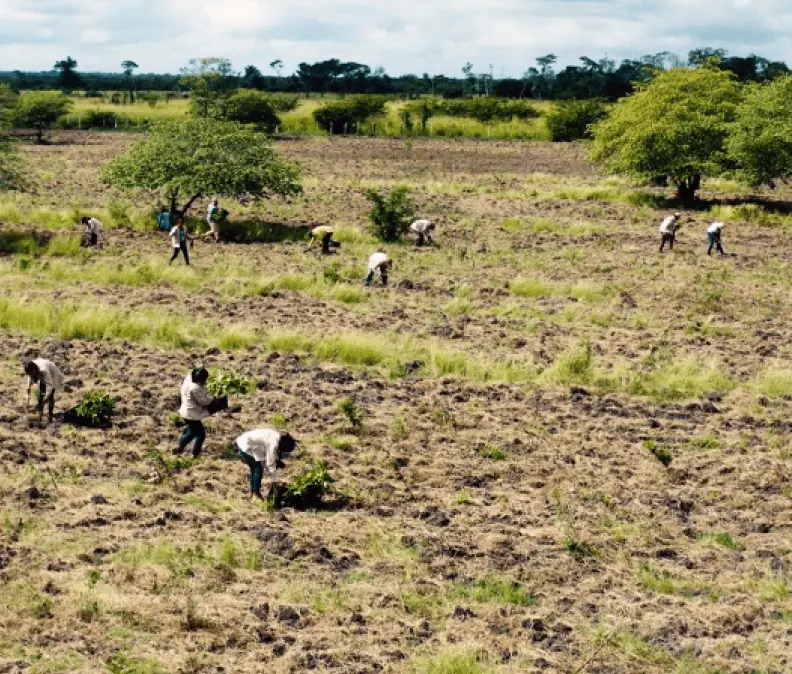
Planting happens in the rainy season, grass is cut back while it competes with the seedling, and every visit is measured and recorded. The game skips ahead in time to teach this, without predicting how real trees will survive.

People planting trees on open land in Yucatán
Photo: Plant-for-the-Planet

The mission

A Yucatán forest that needs help.

According to Plant-for-the-Planet, Campeche lost 8.1% of its forest between 2002 and 2023. Since 2015, the organization has worked to restore and protect the peninsula's Maya forests: a seasonal tropical forest with dry seasons of four to six months. In 2024 its team planted 1,746,074 trees between July 18 and December 5.

The simulator takes place in a teaching landscape inspired by that setting, not on a real plot, and follows the seven steps the organization uses to describe its work:

  1. 1Analyze soil, rainfall and species
  2. 2Collect seeds
  3. 3Grow seedlings in a nursery
  4. 4Prepare the site by clearing grass
  5. 5Plant in the rainy season
  6. 6Control competing grasses
  7. 7Monitor and learn
Restoration in Yucatán plant-for-the-planet.org (opens in a new tab)

How it plays

Observe, decide, plant by hand and come back.

  • Guided mode with hints, plus a free challenge with no help
  • Keyboard and mouse, touchscreen or controller
  • Phone and computer, right in the browser
  • No accounts, no ads, no personal data
  • A final report on skills, not on trees “saved”
  • Music and ambient sound generated on your device

What this simulator is not

  • It is not an official Plant-for-the-Planet product, and it was not commissioned, certified or scientifically endorsed by the organization. It uses the organization's logos and photos with permission.
  • It does not predict the survival, growth or carbon capture of real trees: the time skips are illustrations.
  • It does not replace local specialists, the landowner's permission or a restoration plan.
  • It is a concept under review: the content has not yet been reviewed by the organization's experts.

A well-planted tree starts with a good decision.

Does your organization want an educational experience like this?

Let's talk about your project LUM360 Project Estimator