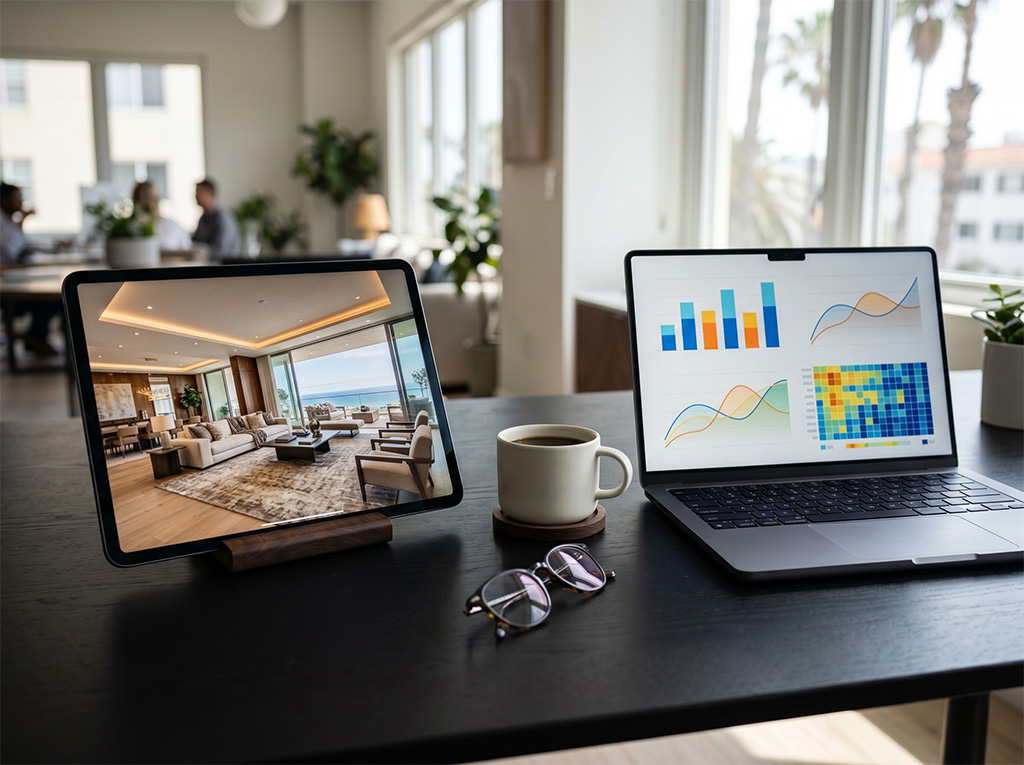
The scenario is familiar to any developer operating in the Riviera Maya: a Canadian or Californian investor is evaluating four projects in parallel, none of them physically exists yet, and the decision will be made in the next two weeks without them setting foot in Mexico. The old toolkit — a PDF of renders, a brochure and a call with the broker — can no longer carry that weight. The friction between "I'm interested" and "I'll sign the contract" is, first and foremost, a visual friction today.
360° virtual tours have been around for more than a decade, but their role has changed completely over the last five years. They stopped being an aesthetic extra and became the layer where the purchase decision is made. This guide is for developers who sell units above $500K USD, work in pre-construction, and need to close with buyers who aren't on the same continent.
The challenge of selling floor plans to international investors
Selling off-plan is, in essence, selling a promise. The promise has to be solid enough for someone to hand over between 20 and 50 percent of the total value of a unit that doesn't exist yet. In local markets, that trust is built on history: the broker knows the client, the client knows the area, and both have seen other developments from the same group deliver. In international sales, all of that disappears.
Data from the National Association of Realtors and publications from JLL México converge on a figure that should guide any pre-construction strategy: more than 70 percent of international vacation-property buyers begin — and move through a large part of — their decision process without physically visiting the property. This isn't a passing trend. It's the new standard.
of international second-home buyers in Mexico make their decision before physically visiting the property. Immersive visual material is no longer optional.
Aggregated source: NAR 2024 reports and JLL Latam Residential Insights 2024.
The problem, then, isn't the volume of interest. It's the developer's ability to sustain that interest from a distance for 30, 60 or 90 days without losing the prospect to the project next door. And to sustain it, the visual material has to answer three questions the buyer always has — though they rarely say them out loud — and that traditional renders can't answer:
- What does it feel like to be inside? A front-facing render of the lobby shows finishes; it doesn't convey scale, rhythm or the light at different times of day.
- What do I see when I look outside? The views aren't decorative. They're the main reason anyone pays a premium in Tulum.
- Where am I within the masterplan? A unit in tower B on the 9th floor is a dot on a plan; until you occupy it, you don't understand why it's worth what it's worth.
Why a render is no longer enough in the luxury market
The static render — even the most sophisticated one, rendered in V-Ray with HDRI and post-produced in Photoshop — works as a brochure, not as a decision tool. It communicates style but flattens the experience. And in the luxury segment, where what sets one unit apart from another is often the quality of the light at six in the evening or the exact angle of the ocean view, flattening is the worst mistake sales materials can make.
The criticism isn't of the render as a technique. It's of the render as the only visual touchpoint. The best developments we see today combine three layers: a photorealistic render for the editorial piece, a navigable 360° tour for real exploration, and cinematic drone footage for the location narrative. The three layers work together. None replaces the others.
The shift from static render to interactive 360° environment
The operational difference between showing a render and showing a 360° environment isn't cosmetic. It changes the entire mechanics of the sales conversation. When the prospect is looking at a render, the broker talks and the client listens. When the prospect is inside a 360° tour, the client drives the exploration and the broker answers specific questions that come up from what the client is looking at in that moment.
This shift from passive to active is what shortens sales cycles. The prospect no longer arrives at the next call with generic questions — what are the finishes like? — but with concrete ones: the master bedroom window, does it face west or the open sea? That difference in the type of question alone signals progress of one or two stages in the funnel.
A well-produced 360° tour doesn't replace the broker. It replaces the first visit, which is the one that almost never happens.
From a production standpoint, the upgrade isn't marginal either. A quality 360° tour of a model apartment uses multi-exposure HDR capture from 8 to 14 points, polygonal stitching, per-scene color control and — when the unit is under construction or exists only on plan — 360° CGI work rendered in stereo. The output is delivered in a proprietary tour engine, with information hotspots, floating menus and metrics connected to GA4. It's a piece of software, not an image.
Accelerating the real estate sales funnel
What a development's sales team measures isn't how many people saw the render. It's how many went from contact to scheduled visit, from visit to offer, from offer to signature. Each of those transitions has a conversion rate and an average time. The 360° tour acts on both variables at once.
On conversion, because a prospect who has explored an immersive tour reaches the next stage with a much higher level of qualification. They're not asking whether they like the style; they already know. They're asking about commercial terms, timelines and technical details. On time, because the need for an in-person visit shrinks or gets postponed. In many cases, the letter of intent is secured before the visit, not after.
Increased time on page and user retention
There's one metric that rarely shows up in agency pitches but that describes the change in behavior better than any other: the average session time on the development page. A development landing page with only renders and a form typically holds the visitor for 40 to 90 seconds. The same page with a 360° tour embedded, well integrated into the scroll and with a CTA to request information, typically triples or quadruples that time.
These ranges aren't universal — they depend heavily on production quality, on where the tour sits in the site's architecture and on traffic — but the pattern is consistent: immersion produces sustained attention, and sustained attention is the input the sales team needs to move the lead through the funnel. Without exposure time, there's no conversion. In that sense, the 360° tour is an attention-buying machine.
There's an additional advantage, less obvious but worth mentioning: 360° tours generate behavioral data. Every hotspot clicked, every scene where the user spent more than 30 seconds, every point where they left the session is information that can be connected to Google Tag Manager and GA4. We return to this point in depth in our guide to measuring engagement in virtual tours.
Integrating virtual tours into your high-ticket prospecting
The most common temptation when a developer produces a 360° tour is to place it on the site's home page like a trophy and consider the integration done. That use wastes 70 to 80 percent of its commercial value. A well-produced tour should live in at least five points of the customer journey:
- On the development landing page, integrated above the fold, not hidden at the end of a long scroll.
- As a direct link in the first-contact email the sales team sends, with a specific UTM parameter so you can measure which prospects opened the tour before the first call.
- Embedded in the physical showroom, on a large vertical screen, so the broker can show units that aren't built yet or are occupied.
- As a video call tool: the broker shares their screen and guides the prospect through the tour in real time, instead of expecting the prospect to explore it alone without context.
- In retargeting campaigns, using the tour's own engagement data as an intent signal to serve specific creatives. The person who spent 4 minutes on the penthouse's ocean view doesn't get the same ad as the one who only explored the lobby.
Showroom integration deserves an extra comment because it's probably where the return is most visible. A showroom with a 360° tour running on a 65-inch screen, with a broker trained to navigate it, converts better than one with only scale models and a set of printed renders. The reason is that the client can — literally — sit down and step into the unit they're considering, and the conversation stops being speculative.
| Capture | Full-frame DSLR + circular fisheye (7-stop HDR) |
|---|---|
| 360° CGI | 3ds Max + V-Ray Spherical + Mettle SkyBox |
| Stitching | PTGui Pro with polygonal stitching |
| Tour engine | 3DVista Virtual Tour Pro (self-hosted) |
| Hosting | Hostinger Business · static files |
| Analytics | GTM + GA4 · custom events per hotspot |
| Delivery | Complete source code delivered to the client (digital sovereignty) |
One last practical point: the 360° tour doesn't replace the sales team; it empowers it. The brokers who convert best with this tool are the ones who use it as a live script during video calls, not the ones who leave it as self-service material. The best conversion we've seen in Riviera Maya developments happens when the broker starts the call, shares their screen with the tour and leads the prospect through an 8- to 12-minute narrative sequence — lobby, view, master, terrace, amenities, masterplan — answering questions live. That format combines the best of in-person selling with the reach of a video call. For the specific presentation and closing protocol with buyers from the US and Europe — including the bilingual document stack, the structure of the video call and the legal framework of a remote closing — our article on how to present your pre-construction project to international buyers without an in-person visit develops that guide in detail.
Turn your masterplan into a remote buying experience.
If you sell units above $500K USD and work with international buyers, let's talk. A 30-minute session is enough to assess whether a 360° tour is the piece your sales materials are missing.